

When a factory's equipment fails and the replacement part is no longer produced, operations can grind to a halt. These discontinued automation parts - like PLCs, HMIs, and VFDs - are critical to maintaining older systems still widely used in Polish factories. Sourcing these parts quickly saves time and money, avoiding costly system upgrades or downtime that can cost up to 500,000 zł per hour.
Key points:
- Why demand is rising: Supply chain issues, reliance on older systems, and high upgrade costs.
- Challenges: Longer lead times, semiconductor shortages, and limited stock from OEMs.
- Solutions: Specialized platforms like Gal-Industry help locate rare parts with fast delivery and warranties.
- Industries affected: Oil, gas, pharmaceuticals, packaging, and CNC manufacturing.
For factories, finding discontinued parts is often the only way to keep production running smoothly without the expense of replacing entire systems.
Problems Driving Demand for Discontinued Parts
Supply Chain Disruptions and Part Shortages
The global supply chain is still feeling the strain in 2026, leading to a serious shortage of critical components. Semiconductor manufacturers are prioritizing newer technologies like electric vehicles, artificial intelligence, and consumer electronics. This shift has left older automation platforms struggling to secure necessary parts. Bryan Hellman from Industrial Automation Co. explains:
Industrial automation - especially legacy platforms built on older process nodes - continues to face supply risk as manufacturers concentrate production on newer architectures.
Lead times for essential automation components are now 10–15% longer than they were before 2024. This makes waiting for replacements, like a PLC or servo drive, a risky strategy when equipment fails. Geopolitical tensions, tariffs, and export controls only add to the uncertainty of delivery timelines. As manufacturers phase out older product lines to focus on modern systems, authorized distributors often run out of stock. This creates a surge in demand for discontinued parts, as factories have no choice but to rely on these legacy components to keep operations running.
Legacy Systems Still Running in Factories
A significant number of Polish factories are still operating automation systems installed 10–20 years ago. For these facilities, unplanned downtime can lead to massive production losses, making the reliability of these older systems absolutely essential. Equipment like the Allen-Bradley SLC 500, Siemens S7-300, and Mitsubishi FR-A740 inverters has proven dependable over the years. But when a single part fails, finding an exact replacement is crucial because these systems are built around specific components.
Take, for instance, a packaging facility in late 2025. When a legacy variable-frequency drive controlling a key conveyor line broke down, the OEM replacement had a lead time of over two months. Instead of waiting, the facility sourced a compatible Yaskawa drive with matching electrical specs and installed it within 48 hours. This quick fix prevented production losses that could have reached six figures. Stories like this highlight why factories often turn to discontinued parts - they avoid the risks and costs of using new, potentially incompatible components. For many, finding the right replacement is the only way to dodge expensive, system-wide upgrades.
High Costs of Upgrading Systems
Upgrading an entire automation system isn’t just about buying new hardware. It often involves extensive rewiring, reprogramming, and retraining staff. On top of that, shutting down production during the transition adds even more to the cost.
Bryan Hellman from Industrial Automation Co. sums it up perfectly:
Downtime is one of the most expensive words in manufacturing. Every minute a production line sits idle because of a failed or missing part means lost revenue, missed deadlines, and frustrated customers.
For factories, their current machinery still delivers value. Extending the life of these systems through targeted repairs helps maximize their return on investment. Considering that upgrading can cost hundreds of thousands or even millions of złoty, many procurement teams prioritize sourcing obsolete components. This approach not only keeps costs in check but also ensures operations remain smooth, making specialized sourcing solutions a critical part of effective maintenance strategies.
sbb-itb-52f18a4
Solutions for Sourcing Discontinued Automation Parts
Using Specialized Platforms for Hard-to-Find Parts
When production grinds to a halt due to missing components, quick sourcing becomes a top priority. Specialized platforms bring together inventories from brokers, salvage houses, and trusted distributors. These platforms make it possible to track down rare or discontinued parts that traditional suppliers simply can't provide.
Take Gal-Industry as an example. They maintain a vast stock of hard-to-find parts from brands like Siemens, ABB, and Allen-Bradley. Orders placed before 4 PM CET can even be shipped the same day - a lifesaver when every minute of downtime counts. To build buyer confidence, many suppliers offer warranties of up to 24 months on both new and refurbished items. Plus, with free returns within 14 days, compatibility issues become less of a headache.
These platforms go beyond just selling parts. Many also run asset recovery programs, buying surplus equipment from decommissioned production lines. This creates a sort of circular economy - what’s obsolete for one factory could be a critical spare for another. Refurbished components undergo thorough testing, including continuity and load checks, ensuring they’re ready to perform.
Such sourcing strategies are a key step in strengthening your maintenance and inventory plans.
Maintenance Planning and Stock Management
Tackling supply chain challenges and system vulnerabilities starts with smarter inventory and maintenance practices. Begin by auditing your production lines. Document every detail - part numbers, firmware versions, and installation dates - to create a solid inventory baseline. Then, rank components based on how their failure would impact operations. For instance, even a low-cost sensor failure can halt production, making it essential to prioritize such high-impact parts.
"A resilient spare parts strategy doesn't just protect your operations; it transforms maintenance from reactive firefighting into proactive stability".
This shift in mindset emphasizes the value of setting reorder points based on operational impact rather than just stock levels. Standardizing equipment across production lines can also cut spare-parts costs by 20–30%. For example, using the same drive families or PLC platforms allows one spare to serve multiple machines.
Another smart practice is creating a "digital spare." This involves documenting configuration files and firmware versions, which speeds up replacements when needed. Additionally, test stored electronic parts quarterly by powering them up. This helps catch issues like capacitor degradation and ensures firmware is still functional.
Market Trends Showing Increased Demand
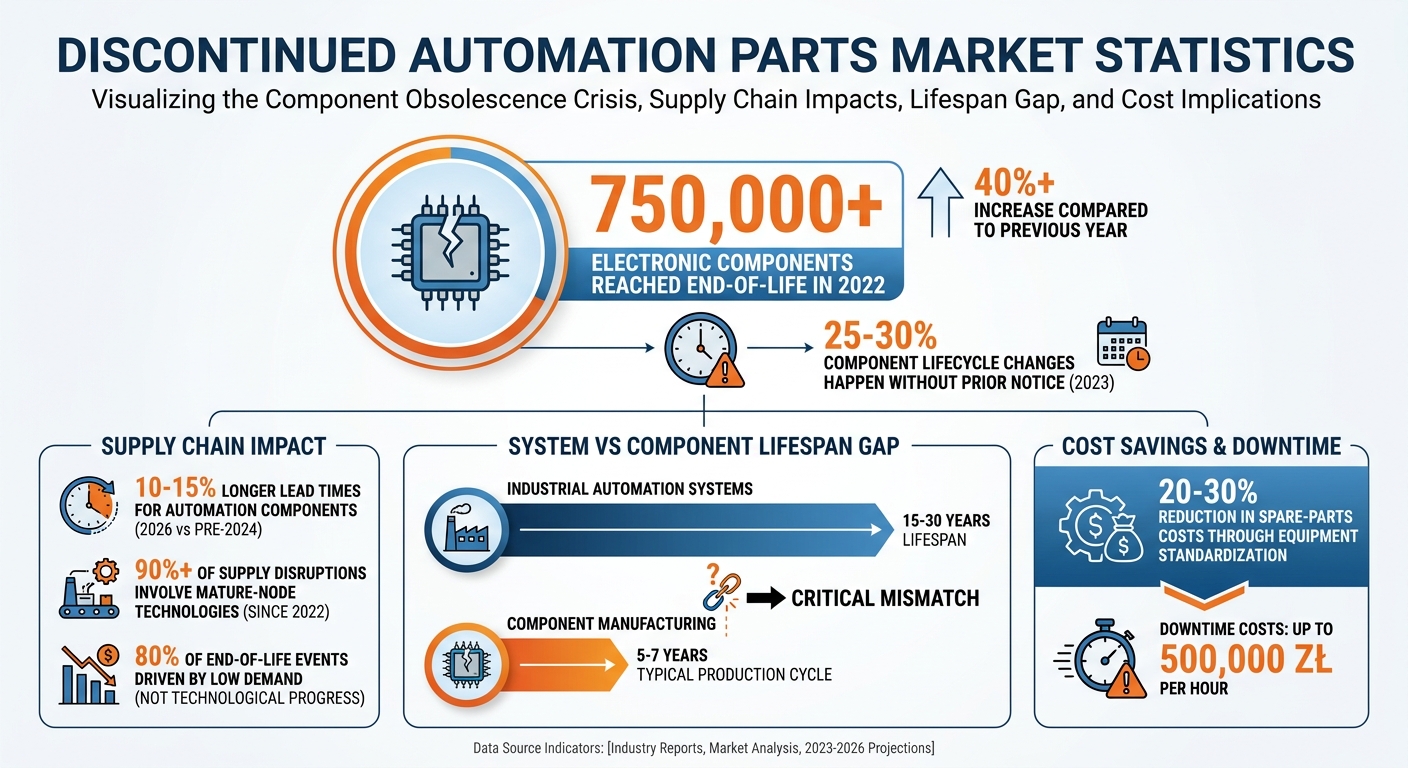
Discontinued Automation Parts Demand Statistics and Market Trends 2022-2026
Growth in the Industrial Automation Spares Market
The market for discontinued automation parts is undergoing a major shift. In 2022, over 750,000 electronic components reached end-of-life - a jump of more than 40% compared to the previous year. This highlights how obsolescence has evolved from an occasional issue to a constant challenge in the supply chain. While industrial automation systems are built to last 15 to 30 years, many of their components, like integrated circuits, are only manufactured for five to seven years. This mismatch between system lifespan and component availability means that once a part becomes unprofitable to produce, it often disappears from the market. By 2023, around 25–30% of component lifecycle changes happened without any prior notice, leaving manufacturers scrambling to source replacements.
Looking ahead to 2026, lead times for critical automation components are expected to remain 10–15% longer than pre-2024 levels. Semiconductor foundries are prioritizing advanced chips (below 7 nm) for AI and consumer electronics, limiting production capacity for the mature-node technologies that most industrial automation systems rely on. Since 2022, over 90% of supply disruptions have involved these mature technologies.
"The automation squeeze is not a short-term disruption - it's a structural shift." – Bryan Hellman, Industrial Automation Co.
Nearly 80% of end-of-life events are driven by low demand rather than technological progress. This means that even if a factory depends on a specific part, it may vanish if it no longer makes financial sense to produce it. These market dynamics are creating a growing sense of urgency for industries that rely heavily on discontinued parts.
Industries Leading the Demand
As supply constraints reshape the market, some industries are feeling the pressure more than others. Continuous-process industries like oil, gas, and pharmaceuticals face particularly high stakes. In these sectors, system downtime can cost tens of thousands of złoty per hour. For them, sourcing discontinued parts isn’t just about saving money - it’s crucial for keeping production lines operational.
Discrete manufacturing sectors, such as packaging plants and CNC machining facilities, also depend heavily on older PLCs and drives. When these components fail, finding discontinued replacements quickly is essential to avoid prolonged downtime and costly production halts.
Robotics and CNC operations have a steady demand for precision components like FANUC Alpha servo amplifiers and Yaskawa SGDH amplifiers. Replacing entire robotic systems is often far more expensive than sourcing the discontinued parts needed for repairs. Similarly, many general manufacturing facilities continue to rely on older systems like Allen-Bradley SLC 500 and Siemens S7-300 PLCs. Although these systems are officially labeled "obsolete", they remain critical to daily production needs.
Competition for automation components is heating up. Industries like electric vehicles, robotics, and energy are increasingly outbidding traditional manufacturing for semiconductor supplies. This "2026 Automation Squeeze", driven by semiconductor shortages, stricter trade policies, and logistical challenges, is making it harder than ever to secure key components like PLCs, servo drives, and HMIs.
Conclusion
Main Points
The need for discontinued automation parts is growing rapidly, driven by supply chain issues, reliance on legacy systems, and the steep costs of upgrading entire setups. Systems like the Allen-Bradley SLC 500 and Siemens S7-300 are built for long-term use, often lasting 10 to 15 years, but the production of their components often stops long before these systems reach the end of their lifecycle. Replacing a single faulty part is usually far more cost-effective and quicker than replacing an entire production line. This makes finding trustworthy sources for these components absolutely critical.
Working with Reliable Suppliers
When time is of the essence, collaborating with a specialized supplier can make all the difference. Gal-Industry leverages a global network to source rare, legacy, and "new old stock" (NOS) components that original manufacturers no longer produce. This network is vital for securing high-demand parts like Mitsubishi FR-A740 inverters or Yaskawa SGDH servo amplifiers, which can become hard to find quickly.
To ensure quality, Gal-Industry performs thorough, multi-point testing on all components and backs them with a 24-month warranty. This careful process reduces the risk of counterfeit parts, keeping operations safe and dependable. Their fast delivery and straightforward return policy further help minimize downtime.
"Obsolete doesn't mean outdated; it means essential. The right part, delivered at the right time, can keep your business moving and your machines productive." – All Industrial Automation
FAQs
How can I verify a discontinued PLC/HMI/VFD will be compatible?
To make sure a discontinued PLC, HMI, or VFD works seamlessly with your system, it's crucial to compare the key specifications and communication protocols of the replacement with your existing setup. Look closely at details like model numbers, datasheets, and manuals to ensure the following align:
- I/O configurations: Verify that the input/output setups match your requirements.
- Protocols: Check for compatibility with communication standards like Modbus or Profibus.
- Voltage and current ratings: Confirm these are suitable for your system.
- Firmware versions: Ensure the replacement device runs firmware that supports your system's needs.
If documentation is sparse, especially for older systems, reaching out to suppliers or consulting specialists can be a valuable step in confirming compatibility. Their expertise can help bridge gaps in information and ensure a smooth integration.
How do I avoid counterfeit or untested obsolete automation parts?
To steer clear of counterfeit or untested obsolete automation parts, it’s crucial to buy from reputable suppliers that guarantee authenticity and conduct thorough testing. Reliable vendors, especially those focused on discontinued automation components, often back their products with warranties lasting up to 24 months. For critical parts like PLCs, HMIs, or power supplies, always ask for documentation or certification to confirm their quality and dependability before making a purchase.
Which spares should I stock first to cut downtime risk?
To reduce downtime, focus on keeping essential legacy components in stock, particularly PLC parts from well-known brands like Siemens and Allen-Bradley. These components are frequently sought after because they are no longer in production but remain crucial for keeping older systems running smoothly.