

Sourcing discontinued PLC parts can be a challenge, but the right approach can save time, reduce downtime, and cut costs. Here's how to keep your legacy machinery running smoothly:
- Identify the exact part needed: Gather details like the manufacturer, model number, firmware version, and I/O specifications to avoid compatibility issues.
- Use trusted suppliers: Companies like Gal-Industry in Poland specialize in hard-to-find industrial automation parts, offering same-day shipping, warranties, and free returns.
- Consider used or surplus parts: Refurbished components can be up to 50% cheaper than new ones but ensure they are tested and come with a warranty.
- Plan ahead: Maintain an inventory of critical spares, track end-of-life notices, and build relationships with reliable suppliers to minimize downtime risks.
Key takeaway: Accurate part identification and proactive planning are essential to sourcing discontinued PLC components efficiently while keeping costs under control.
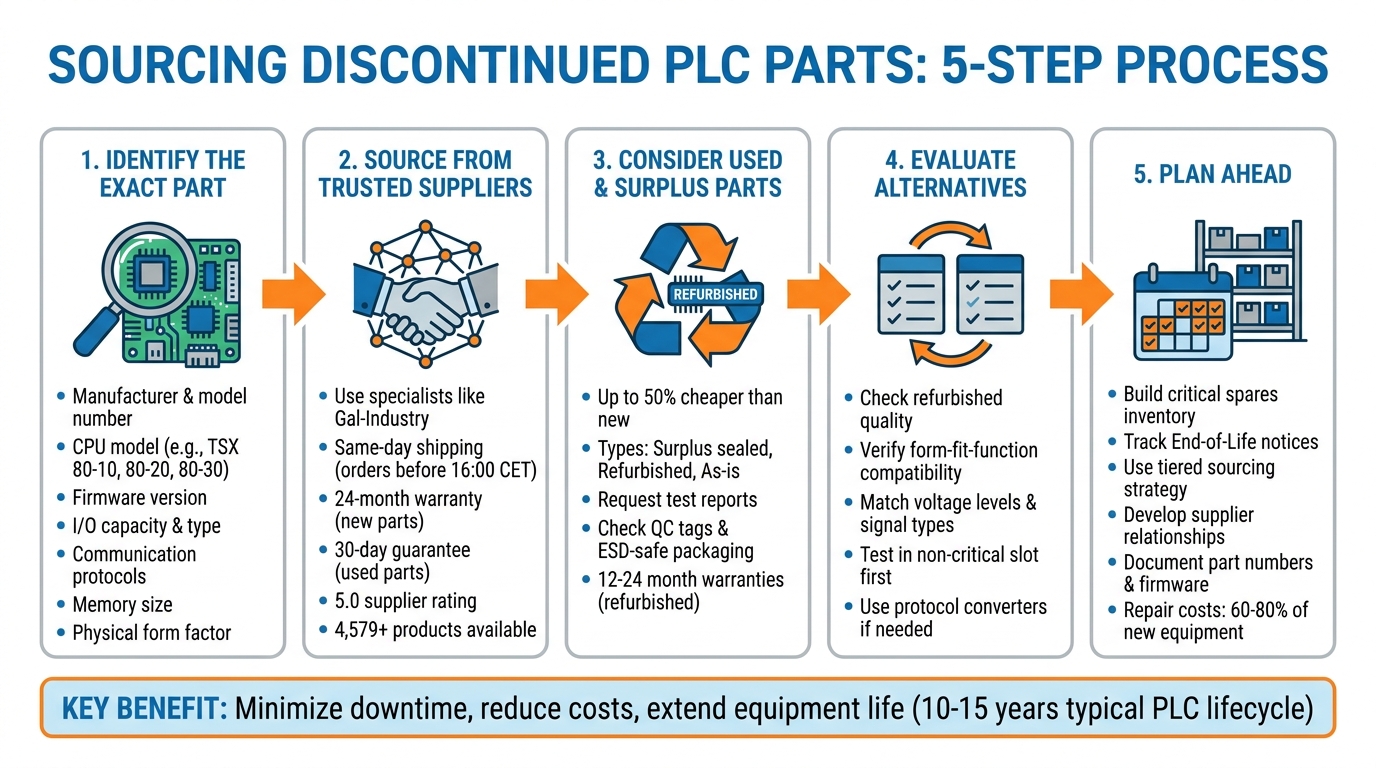
5-Step Process for Sourcing Discontinued PLC Parts
Step 1: Identify the Exact PLC Part You Need
Pinpointing the precise PLC component you need is crucial to sidestep expensive downtime. Even a minor mismatch in model numbers or firmware versions can lead to compatibility issues, so accuracy is key.
Gather Technical Specifications
Start by examining the PLC's label for details like the model, serial number, and revision. If the label is unreadable, check the user manual or the equipment's nameplate for this information.
Make sure to document everything, including the CPU model (e.g., TSX 80-10, 80-20, or 80-30), I/O modules, communication modules, and firmware version. For older systems like the Telemecanique TSX80, you may need DOS-based programming tools such as PL7-2 or PL7-3.
Here’s a breakdown of what to record:
| Parameter | Details to Identify for Replacement |
|---|---|
| Manufacturer | Original brand (e.g., Telemecanique, Schneider Electric, Allen-Bradley) |
| CPU Model | Exact series and version (e.g., TSX 80-10, 80-20, 80-30) |
| Firmware Version | Internal software version of the controller/module |
| I/O Capacity | Number and type of input/output points (Digital vs. Analogue) |
| Communication | Supported protocols (e.g., RS-485, Modbus, Ethernet, Modbus TCP/IP) |
| Memory Size | Total memory capacity (e.g., 2 KB to 64 KB) |
| Physical Form | Mounting type or rack/slot compatibility |
Having all these details on hand ensures you can cross-check compatibility effectively.
Verify Compatibility with Your System
Once you’ve gathered the specifications, confirm they align with your system’s electrical and physical requirements. For I/O modules, check for matching voltage levels (e.g., 24 VDC vs. 120 VAC), logic types (sourcing vs. sinking), and output types (relay, transistor, or triac). Analogue signals require particular attention to ensure compatibility in range and type, such as 4–20 mA, 0–10 V, RTD, or thermocouple inputs.
"If you don't match the electrical behavior, the best program conversion in the world won't help." – Bryan Hellman, Industrial Automation Co.
Also, confirm cross-compatibility within the same manufacturer’s product lines. For instance, some TSX 80 components may work with TSX 17 series modules. If you’re considering third-party or surplus modules, ensure they’ve been tested and that their firmware version aligns with your current system. This step can save you from costly integration errors.
sbb-itb-52f18a4
Step 2: Source from Gal-Industry
Once you have your part specifications ready, the next step is sourcing. If you're searching for discontinued or rare PLC components, Gal-Industry, based in Kraków, Poland, is a go-to solution. The company specializes in surplus stock for the industrial automation sector, offering a catalog of over 4,579 products from top brands like Siemens, Allen Bradley, ABB, and Schneider Electric.
What Gal-Industry Provides
Gal-Industry ensures fast and reliable service with same-day shipping for orders placed before 16:00 CET. They back their products with a 24-month warranty for new parts and a 30-day guarantee for used ones. Plus, you can take advantage of free returns within 14 days, giving you peace of mind if a part isn't the right fit for your needs.
Their 5,0 supplier rating highlights their expertise in industrial electronics and robotics. The inventory includes everything from basic I/O modules to advanced robotics components. Prices range widely, from a few hundred euros to over €19,663.40 for specialized equipment like the KUKA KR 10 R900-2.
Tips for Using Gal-Industry's Online Catalog
To find what you need, simply enter the exact part number (e.g., "6ES7517-3UP00-0AB0") into the search bar. If you don't see results, try removing dashes or spaces. You can also use the "Filter products" feature to refine your search by price or brand.
The platform offers real-time stock updates, which is crucial for rare or discontinued items - sometimes only one unit is available. If a product isn't listed or lacks a price, the "Send RFQ" (Request for Quote) button lets you check availability and discuss terms with their team. This feature is especially helpful for bulk orders or confirming compatibility before making a purchase. These tools make it easier to secure the components you need, paving the way for exploring additional sourcing options later.
Step 3: Consider Used and Surplus PLC Parts
After securing new parts through Gal-Industry's catalog, it’s worth exploring used and surplus options to manage costs and address availability challenges.
When new components are either unavailable or too expensive, used and surplus parts can be a smart alternative. Refurbished and surplus items often cost around 50% less than new OEM parts, making them an economical way to maintain older systems.
How to Evaluate Used Parts
Not all used parts are created equal. They fall into three main categories:
- Surplus sealed: These are factory-sealed units.
- Refurbished: Inspected, repaired to meet OEM standards, and load-tested.
- As-is: Sold with little or no testing.
"Refurbished = inspected, repaired to OEM spec, and tested under load." - Bryan Hellman, Industrial Automation Co.
To ensure quality, always request test reports that confirm the component was validated under operational conditions, not just powered on. Look for QC tags, tamper seals, and evidence of advanced testing like thermal cycling or vibration simulations - especially for parts used in harsh environments. Packaging is another indicator of quality: components should arrive in ESD-safe bags and anti-static foam to protect against electrostatic discharge during shipping.
Warranty terms are also key. Reputable refurbishers usually offer 12 to 24 months, while "as-is" parts often don’t include any safety validation.
By following these steps, you can confidently select reliable used components and take full advantage of Gal-Industry's buyback service.
Using Gal-Industry's Buyback Service
Gal-Industry's buyback programme turns unused inventory into funds for essential replacements. If you have surplus stock left over from cancelled projects or equipment upgrades, you can sell it back in two ways: a direct purchase for immediate cash or consignment solutions that may yield higher returns.
"GAL-Industry.com is a specialist in recovering value from surplus stock in the industrial automation and manufacturing sectors. We help companies turn idle inventory into profit by purchasing surplus components directly or by offering flexible consignment solutions." - Gal-industry.com
Parts sourced through this programme come with a 30-day warranty and return policy. Make sure to test all components during this window to confirm compatibility. This strategy not only helps you find discontinued parts but also allows you to recover value from equipment you no longer need.
Step 4: Look at Refurbished Parts and Compatible Alternatives
When new parts are no longer manufactured, refurbished components and compatible alternatives can be a practical solution. These options help keep older systems running smoothly without requiring a full upgrade, offering dependable performance when exact replacements are unavailable.
However, ensuring quality and compatibility is crucial. A well-restored refurbished part can perform just like a new one, but a poorly matched alternative might cause integration problems. Below, we'll explore how to assess refurbished parts and ensure alternatives meet your system's needs.
Checking Refurbished Parts Quality
Refurbishment, when done correctly, involves restoring parts to meet original manufacturer standards through rigorous inspection, repair, and testing processes.
"True refurbishment isn't about cleaning or repackaging - it's a controlled process of restoring equipment to original factory performance standards." – Bryan Hellman, Industrial Automation Co.
Professional refurbishers use certified test benches to evaluate components for electrical, mechanical, and functional performance. This includes testing analog and digital I/O, communication interfaces (such as EtherNet/IP, Modbus, PROFIBUS), and thermal stability. Advanced stress tests, like thermal cycling and vibration simulations, help identify hidden faults that might not show up during a simple power-on test.
Always ask for detailed test reports that include serial-numbered data and inspection logs. These should confirm the part was tested in controlled environments, not just powered on briefly. Ensure firmware versions align with your system to avoid communication errors. Additionally, high-wear parts like capacitors, relays, and fuses should be replaced during refurbishment.
Warranty terms are another key indicator of quality. Reliable refurbishers often provide 12- to 24-month warranties, similar to those offered for new surplus parts. In contrast, "as-is" parts usually lack safety checks and come without warranties. Lastly, pay attention to packaging - components should arrive in ESD-safe bags with anti-static foam, tamper seals, and quality control tags.
Finding Form-Fit-Function Alternatives
When exact replacements aren't available, form-fit-function alternatives can be a viable option - provided they match the original part's electrical properties and physical dimensions. This approach minimizes the need for significant reprogramming or rewiring, helping maintain system functionality. As discussed in Step 1, precise compatibility is crucial to avoid costly integration errors.
Start by ensuring input voltages (e.g., 24 VDC vs. 120 VAC), signal types (sourcing vs. sinking), and output types (relay, transistor, or triac) align perfectly. Even the best programming can't compensate for mismatched electrical behavior. For analog signals, confirm that ranges (e.g., 4–20 mA, 0–10 V) and sensor types (RTD, thermocouple) are fully compatible.
Replicating both the electrical behavior and physical layout is essential to avoid reprogramming. For communication needs, consider using protocol converters or Ethernet–serial bridges (e.g., Modbus RTU to Modbus TCP/IP) to allow new controllers to work with older devices without overhauling the entire network.
Before integrating an alternative into full production, test it in a non-critical slot or bench rack to ensure it responds to signals just like the original. Document the nameplate details of your current module - take a clear photo of the full identifier, including series and firmware markings - before ordering. Also, check whether the replacement includes accessories like terminal blocks, front connectors, or memory cards, as these are sometimes sold separately.
"A module that arrives tomorrow is often worth more than a cheaper one that arrives next month." – Automation Planet UK
To simplify the process, platforms like Gal-Industry's online catalogue provide detailed specifications and compatibility details. Their technical support team can also assist in matching replacements when you're unsure about cross-compatibility, complementing the verification steps outlined above.
Step 5: Plan Ahead to Prevent Downtime
Preventing downtime isn't just about having spare parts on hand; it's also about being proactive with inventory management and building strong supplier relationships. When a critical PLC component fails, production halts immediately, leading to costly losses. The best way to avoid this scenario? Plan ahead by maintaining a well-thought-out inventory of critical spares and partnering with reliable suppliers - long before any issues arise.
Build an Inventory of Critical Spares
Start by focusing on the most essential components. Use CMMS software to digitise your Bill of Materials (BOM), which helps avoid duplication and flags items with long lead times.
Next, categorise your components based on their importance. For example, "Single Point of Failure" assets - those that can bring production to a complete stop - should always have original equipment manufacturer (OEM) spares readily available. Some common failure points include power supplies with worn-out capacitors, CPU batteries nearing the end of their lifespan, and I/O modules with deteriorating relay contacts. The table below highlights these common issues:
| Component | Failure Mode | Symptom |
|---|---|---|
| Power Supply | Capacitor degradation | No RUN LED, intermittent restarts |
| CPU Battery | Lithium-ion exhaustion | Program loss, ERROR LED flashing |
| I/O Modules | Relay contact wear | Stuck outputs, false inputs |
| EPROM | Data corruption | Startup faults, checksum errors |
To stay ahead of obsolescence, keep track of ageing components and request End-of-Life (EOL) or End-of-Service (EOS) notices from manufacturers. When a discontinuation is announced, take advantage of "last time buys" to secure remaining stock from authorised distributors.
"Obsolescence management is a capital-allocation discipline: protect uptime while preventing dead stock accumulation." – Andrew Bennett, Product Lead, SPARETECH
Adopt a tiered sourcing strategy to manage inventory costs effectively:
- Tier 1 (Critical): Stock OEM-only parts on-site to ensure availability.
- Tier 2 (Essential): Use OEM or Original Equipment Supplier parts, as needed.
- Tier 3 (Non-Critical): Opt for aftermarket or refurbished components.
This tiered approach ensures you’re not overstocking low-priority items while still safeguarding against costly downtime.
Develop Long-Term Supplier Relationships
Having a strong inventory is only part of the solution. Building solid, long-term relationships with suppliers is equally important to ensure uninterrupted operations. Reliable suppliers, like Gal-Industry, offer more than just parts - they provide priority access to limited inventory and notify you when hard-to-find components become available. Given that most PLCs have a typical lifecycle of 10–15 years before manufacturer support ends, having a dependable supplier is invaluable.
Gal-Industry doesn’t just supply parts; they also offer technical expertise to help cross-reference obsolete components and recommend modern replacements that integrate seamlessly into your systems. This kind of support is crucial during emergencies, saving time and reducing stress. They also offer services like "maintenance replacement", where a refurbished part is shipped immediately while your faulty unit undergoes repair.
"You should rely on a stable and trusted business partner who, in addition to knowledge, has the experience, openness to the customer and, above all, the facilities to supply and maintain industrial automation and electronics components." – PLCconnex
To make the most of your supplier partnership, audit your production line to document part numbers, serial numbers, firmware versions, and installation dates. Sharing this information with your supplier enables them to predict potential failures and recommend proactive solutions. Additionally, consider buyback programmes to sell unused or surplus stock, which can help offset the cost of acquiring legacy components.
Planning ahead is about more than just avoiding downtime - it's about creating a system that runs smoothly, even when challenges arise.
Conclusion
Finding discontinued PLC parts doesn’t have to be a hassle. The key is accurate identification - pinpointing details like CPU models, I/O types, and firmware versions. This level of precision helps you avoid expensive mistakes and ensures compatibility with your existing systems. Think of it as laying a solid foundation for sourcing dependable components.
Once you’ve nailed down what you need, the next step is partnering with reliable suppliers. Companies like Gal-Industry specialize in hard-to-find and discontinued parts. They offer technical expertise for cross-referencing obsolete components, quick solutions like same-day shipping, and even 24-month guarantees. When legacy inventory moves fast, having a trusted supplier in your corner means quicker quotes and immediate support during critical moments.
Planning ahead is just as important as sourcing the right parts. Keep an inventory of essential spares, monitor end-of-life notices, and explore refurbished options to cut downtime and repair costs. Did you know that repairing older hardware typically costs only 60% to 80% of buying brand-new equipment? It’s a smart way to keep older machines running smoothly without breaking the bank.
FAQs
What if the PLC label is missing or unreadable?
If the PLC label is missing or unreadable, reaching out to specialised suppliers of obsolete automation components can be a smart move. These experts have in-depth knowledge of legacy systems and can help you identify compatible alternatives or refurbished parts that align with the original specifications. Even without clear labels, they can guide you in finding the right replacements to keep your equipment running smoothly.
How can I confirm a used PLC part was properly load-tested?
To properly test a used PLC part, it's important to verify its functionality through structured methods. One approach is to follow procedures similar to factory acceptance testing (FAT), ensuring the part meets the necessary specifications. You can also simulate operational conditions in a controlled environment to observe its performance and confirm reliability before reuse. For extra confidence, consider using certification services to validate its readiness.
When should I stock spares versus upgrading the PLC system?
Deciding whether to stock spare parts or upgrade your PLC depends largely on its current state. If your PLC is obsolete - meaning the manufacturer no longer supports it, parts are difficult to find, or it demands constant maintenance - an upgrade might save you money in the long run. On the other hand, if your system is still supported and plays a critical role in operations, sourcing spare parts from trusted suppliers can keep it running smoothly for years. Planning ahead is key to maintaining reliability while managing costs effectively.