

- Identify Critical Spare Parts: Focus on components that halt production (e.g., PLC CPUs, power supplies). Use K-classification (K1-K3) or VED analysis to prioritize.
- Build Detailed BOMs: Create a single source of truth for parts, linking inventory, suppliers, and production schedules to avoid delays.
- Classify Lead Times: Stock long-lead-time parts strategically (e.g., custom gearboxes), while using Kanban or on-demand systems for short-lead-time items.
- Integrate Predictive Maintenance (PdM): Use IoT sensors to predict failures, reducing unplanned downtime by up to 50%.
- Automate Procurement: Link CMMS with ERP systems to automatically order parts, avoiding shortages and delays.
- Standardize Components: Simplify inventory by using common parts across equipment, reducing repair time and costs.
- Source Rare Parts Efficiently: Monitor end-of-life parts, use cannibalization, and partner with repair vendors to ensure availability for legacy equipment.
Key Takeaway
Unplanned downtime can cost Polish factories between 10,000–90,000 PLN per hour. By focusing on critical parts, predictive maintenance, and automation, you can save millions annually while ensuring production continuity.
5 Proven Strategies to Improve Spare Parts Management | eMaint CMMS
1. Identify Critical Spare Parts
Not all spare parts are created equal. Some can bring production to a screeching halt, while others might only cause minor delays. In Poland, many industries use the K-classification system to sort these components: K1 parts are those that immediately stop production with no workaround, K2 parts allow for reduced performance or temporary fixes, and K3 parts have minimal impact on operations.
Interestingly, just 15–20% of automation spare parts are responsible for over 80% of downtime, with unavailability being a factor in 70% of these cases. This highlights the importance of focusing on a small group of critical components - like PLC CPUs, power supplies, VFDs, and safety modules - that are most likely to disrupt production.
Impact on Reducing Downtime
Prioritising critical spare parts can significantly reduce costly disruptions. One manufacturing company that implemented a spare parts criticality tool reported annual savings of over 4 million PLN by improving procurement strategies and minimising downtime. When a single halted production line can cost hundreds of thousands of PLN daily, it’s clear why identifying and stocking these parts is essential.
VED Analysis (Vital, Essential, Desirable) offers a practical framework for making stocking decisions. For instance:
- Vital components (e.g., Siemens S7-1200 CPUs or Allen-Bradley PowerFlex drives) can stop production entirely if they fail.
- Essential components (e.g., I/O modules or HMIs) might allow temporary workarounds.
- Desirable components (e.g., indicator lamps or cables) typically cause little disruption.
Relevance to Polish Industrial Contexts
In Poland, maintenance teams (Utrzymanie Ruchu) often clash with finance departments over the issue of "dead stock." The key to resolving this is aligning on a shared understanding of risk. For example, comparing the koszt przestoju (cost of downtime) with the koszt zapasu (inventory cost) makes the stakes clear. A 200 PLN sensor that can halt a production line earning 100,000 PLN daily is worth keeping in stock.
"Sam fakt, że część jest tania, nie oznacza, że powinna być dostępna 'od ręki', ani odwrotnie – że droga część musi zawsze leżeć na półce." - Techneau.pl
For older equipment, especially in situations where OEM support has ended, certain parts should be designated as rezerwa strategiczna (strategic reserve). This is particularly critical for discontinued automation components, where lead times can stretch from 12 to 26 weeks.
Focusing on critical spare parts is the first step in building a more efficient and cost-effective spare parts management strategy.
2. Build Detailed Bills of Materials (BOMs)
Creating a detailed Bill of Materials (BOM) is a crucial step in refining your spare parts planning. A well-structured BOM acts as a Single Source of Truth, linking design data with inventory management, supplier information, and production schedules. This ensures that everyone - engineers, procurement teams, and production managers - works from the same, up-to-date information. The result? Fewer miscommunications and costly delays. By aligning design and procurement processes, collaboration becomes smoother and more efficient.
Impact on Reducing Downtime
Unplanned downtime is a massive challenge, costing industrial manufacturers around $50 billion annually (about 215 billion PLN) worldwide. Over 80% of companies report experiencing such disruptions. A detailed BOM helps mitigate these risks by identifying high-risk components early, avoiding long lead times. For instance, certain microcontrollers that once required 8–12 weeks for delivery now face lead times exceeding 52 weeks. By integrating real-time supplier data, potential risks can be flagged during the design phase, allowing for better preparation.
"Instead of being a static list of parts, the BOM becomes a dynamic dashboard that shows the parts needed in the design along with the latest inventory levels, component availability, lead times, and pricing." - Altium
Modern BOM management tools are shifting away from static spreadsheets to cloud-based platforms that integrate seamlessly with ERP/MRP systems. These tools enable proactive demand forecasting, ensuring production needs align with procurement timelines. This approach minimizes stockouts and allows for quick substitutions when a key component becomes unavailable. For manufacturers in Poland, adopting such strategies not only simplifies operations but also reduces the financial strain of overstocked warehouses.
Relevance to Polish Industrial Contexts
In Poland, effective BOM management plays a key role in controlling inventory costs. As Krzysztof Pawłowski from Lean Action Plan explains:
"Inventory is frozen capital that generates maintenance costs. Often their level represents over 50% of the company's assets"
A detailed BOM strikes a balance between ensuring production continuity and avoiding excessive inventory costs. It provides clarity on what parts are needed, when they are required, and what alternatives are available.
Polish SMEs can benefit from local solutions like ZaPro or Optimakers, which offer affordable alternatives to expensive corporate ERP systems. These platforms help smaller teams manage complex machinery and diverse supplier networks without unnecessary guesswork. By replacing outdated methods with data-driven planning, manufacturers can avoid unexpected stoppages and maintain smooth operations.
3. Optimize Inventory with Lead Time Classification
After identifying critical spare parts and planning your BOM, the next step is classifying lead times to fine-tune inventory management. Not all spare parts arrive on the same schedule - some are delivered within days, while others, like specialized motors, custom valves, or proprietary electronics, might take weeks or even months to procure. By classifying lead times, you can pinpoint which components pose the greatest risk to production uptime. This allows you to stock these parts strategically, avoiding disruptions caused by a single missing component. This approach lays the groundwork for more focused inventory strategies.
Impact on Reducing Downtime
In Poland's heavy industry, even minor component failures can have enormous consequences. A halted production line can cost hundreds of thousands of PLN per day. For parts with K1 criticality and lead times exceeding four weeks, maintaining higher safety stock is essential.
"Treat spare parts obsolescence as a quantified downtime risk, not a purchasing inconvenience." - Andrew Bennett, Product Lead, SPARETECH
A comprehensive classification system takes into account lead time, asset criticality, and lifecycle status. For instance, increasing lead-time variability could hint at an upcoming supply chain issue or product phase-out, enabling proactive sourcing alternatives.
Cost-Effectiveness in PLN
The math here is simple: keeping a high-value spare part on hand is often far cheaper than enduring a prolonged production stop. Imagine a motor with a four-week lead time while your production line generates 200,000 PLN per day. Even if that motor costs 50,000 PLN, the investment is clearly justified. Maintenance (Utrzymanie Ruchu) teams in Poland often use this "cost of downtime" calculation to align with Finance and secure approval for inventory spending.
Many facilities in Poland also rely on consignment warehouses for expensive, long-lead-time parts. This reduces the financial burden of upfront capital while ensuring critical components are always available. Additionally, machine learning tools have improved lead time forecasting by over 30%, helping reduce total inventory costs by around 7% without compromising service levels. These methods directly enhance the resilience of Polish industrial operations.
Relevance to Polish Industrial Contexts
In Polish maintenance departments (Utrzymanie Ruchu), effective spare parts management requires close collaboration between maintenance, logistics, and finance teams. The goal is to strike a balance between the "cost of downtime" and the "cost of inventory." A practical way to approach this is by using a matrix that evaluates lead time, criticality (K1–K3), and demand variability.
- Strategic buffer items: Parts with long lead times and high criticality are stocked with maximum safety levels.
- On-demand parts: Components with short lead times and lower criticality are ordered as needed.
Regular audits also play a key role. For example, reviewing parts that haven't been used in 3–5 years can help free up capital tied to "dead stock." This money can then be reinvested in high-risk, long-lead-time components. Through these strategies, Polish industries can ensure operational continuity while optimizing inventory budgets.
4. Use Predictive Maintenance Integration
After refining inventory and lead time strategies, integrating predictive maintenance (PdM) takes things a step further by using real-time data to tackle mechanical failures before they disrupt operations. This approach works hand-in-hand with optimized lead time classifications, targeting the underlying causes of equipment breakdowns.
PdM shifts spare parts planning from guesswork to precision. Instead of relying on fixed maintenance schedules or waiting for parts to fail, PdM uses IoT sensors to track key metrics like vibration, temperature, pressure, and oil condition. This allows maintenance teams to predict failures and schedule repairs during planned downtimes, avoiding the chaos of emergency shutdowns.
Impact on Reducing Downtime
The numbers speak for themselves: PdM can slash unplanned downtime by 30–50% and reduce unexpected equipment failures by up to 70%. For production lines, this can mean saving thousands of PLN per hour [20,21,22].
One standout example is KLAUS Multiparking, which combined PdM with PLC controllers and Raspberry Pi devices. This setup automated service order generation and spare parts reservation, boosting their production efficiency by 20–30%.
Cost-Effectiveness in PLN
While the initial investment in PdM technology may seem steep, the payoff is quick. Most businesses see a return on investment within 6–18 months. Maintenance costs can drop by as much as 40%, and machine lifespans can increase by up to 40% [20,23].
Take the case of a Polish automotive parts manufacturer: by linking PdM sensors to their CMMS (Computerized Maintenance Management System), they cut reaction times by 40% and saved over 2,000,000 PLN in just one year. The system not only predicted failures but also automatically checked inventory and initiated spare parts orders when needed.
Relevance to Polish Industrial Contexts
For Polish industries, particularly those dealing with a shortage of skilled technicians, PdM offers a practical solution. AI-powered monitoring fills the gaps left by limited human resources. Starting with a pilot program on critical machines - especially those with expensive or hard-to-source components - can showcase the value of this approach.
"Predictive maintenance is not just technology - it is a fundamental change in thinking about production management. We move from reacting to problems to anticipating them." - lubinski.ai
Another growing trend among Polish SMEs is the adoption of subscription-based PdM models. These eliminate the need for large upfront investments, instead offering access to advanced technology through manageable monthly fees. This not only reduces emergency repair costs but also minimizes unnecessary spare parts stockpiling. By improving system reliability, this approach lays the groundwork for further automation in spare parts management.
sbb-itb-52f18a4
5. Automate Parts Request and Procurement
Streamlining spare parts automation starts when predictive maintenance flags potential failures. This process builds directly on the predictive maintenance strategies already in place. Traditional methods, like relying on phone calls, emails, and spreadsheets, slow down procurement and increase the chances of errors, often stretching equipment downtime to days or even weeks. By automating this workflow, maintenance systems can seamlessly connect with procurement processes, ensuring parts are ordered and delivered promptly.
Impact on Reducing Downtime
When a CMMS integrates with an ERP system, it can automatically reserve or order parts as soon as stock drops below set thresholds. This eliminates the risk of last-minute shortages. Combined with predictive maintenance's early fault detection, automated procurement ensures critical parts are always on hand when needed.
Automation also helps identify obsolescence risks early. AI-driven platforms can scan extensive databases to flag parts that are discontinued or nearing the end of their lifecycle, giving teams ample time to source alternatives. Andrew Bennett from SPARETECH highlights the importance of this:
"Obsolescence becomes critical when it threatens asset availability and working capital simultaneously".
Ease of Implementation in Industrial Automation
The foundation of a successful automation strategy lies in clean, organized data. Standardizing material master data with unique part IDs helps avoid duplication and errors. Tools like 2D barcoding and mobile scanners ensure digital inventories align with physical stock.
Integrated systems are another key factor. By linking your CMMS with ERP and Warehouse Management Systems (WMS), maintenance work orders can automatically reserve parts or trigger procurement when needed. For example, platforms like Automa.Net, based in Rzeszów, Poland, provide real-time market data - covering stock levels, lead times, and pricing from over 600 suppliers - directly into ERP systems.
Another practical step is using modular "repair kits" for recurring tasks. For instance, a conveyor overhaul scheduled every 10,000 hours could automatically order a pre-defined kit containing seals, bearings, and fasteners, simplifying logistics and reducing the workload for procurement teams. For frequently used, low-cost items like filters or seals, adopting Kanban or two-bin systems - or even vending machines ("automaty wydające") for tools and consumables - can decentralize storage and automate inventory tracking.
Cost-Effectiveness in PLN
Automated procurement helps avoid tying up capital in overstocked or obsolete items. By using reorder points, these systems ensure a balance between availability and cost efficiency. Proactive ordering also avoids the high costs associated with last-minute shipping of discontinued parts. This approach not only reduces expenses but also supports better inventory management, aligning with downtime reduction goals.
Poland's machinery and automation sector offers additional cost advantages. Local sourcing can save 30% to 45% compared to Western European suppliers while maintaining ISO 9001 standards. Furthermore, the hourly rates for skilled machinists in Poland - ranging from €12 to €18 - are significantly lower than the €30 to €50 rates in Germany.
Relevance to Polish Industrial Contexts
Automated procurement shifts much of the administrative workload to systems, allowing Vendor Managed Inventory (VMI) models to maintain critical stock levels. With VMI, suppliers monitor and replenish inventory remotely, ensuring essential components are always available without manual oversight. This model is gaining popularity among Polish SMEs, particularly through consignment warehousing, which optimizes cash flow.
Creating a shared "language of risk" between Maintenance and Finance teams is equally important. By calculating the "cost of downtime" per hour, companies can justify investing in automated procurement for high-priority (K1) parts as a safeguard against revenue losses. As Techneau.pl aptly notes:
"A small, cheap sleeve or sensor can stop a technological line that generates daily revenues in the hundreds of thousands of zlotys".
Lastly, regular audits of "dead stock" using ERP reports can identify parts unused for 3–5 years that aren't marked as strategic reserves. This prevents the system from reordering obsolete items, keeping inventory lean and efficient. With automated procurement ensuring timely deliveries, the next logical step is to standardize components across equipment for even greater efficiency.
6. Standardize Components Across Equipment
Impact on Reducing Downtime
When your machines share common sensors, drives, and actuators, maintaining them becomes far simpler. Your team can service a wider range of equipment while keeping fewer spare parts in stock. This streamlined approach ensures that critical components are readily available when something breaks, avoiding delays caused by sourcing unique parts. Plus, technicians become more adept at handling a smaller set of standardized parts, which speeds up both diagnosis and repair. With these standardized spares, identifying and replacing components becomes quicker, significantly cutting repair times. This directly reduces downtime, paving the way for a smoother standardization process.
Ease of Implementation in Industrial Automation
To make the most of these downtime reductions, standardization needs to be practical and well-planned. Start by creating "factory standards" (standardy zakładowe) for key component groups like sensors, drives, pneumatic elements, and bearings. Develop an approved list of brands and models that fit your plant's needs. Instead of overhauling everything at once, gradually replace non-standard parts during emergency repairs or planned upgrades. Updating procurement policies to align with these standards prevents the buildup of unique parts that complicate maintenance. For modular components, consider designs that allow entire assemblies to be swapped out quickly, rather than repairing individual parts on-site. This approach simplifies operations even further.
Cost-Effectiveness in PLN
Standardization doesn’t just simplify maintenance; it also saves money. By reducing the number of unique SKUs in your inventory, you lower administrative costs and gain leverage with suppliers for bulk purchases. Regular inventory audits can help identify unused parts - those that have been sitting untouched for 3–5 years - freeing up frozen capital. For high-output Polish factories, downtime can cost anywhere from 4,000 PLN to over 40,000 PLN per hour. These figures highlight the financial advantages of standardizing components.
Relevance to Polish Industrial Contexts
For Polish factories, which often operate a mix of machinery from various international manufacturers, standardization is especially valuable. A diverse inventory can lead to fragmented spare parts and maintenance headaches. A standardization program brings consistency, simplifying repairs and reducing downtime. Using a criticality marking system - classifying parts as K1 (critical), K2 (important but with workarounds), or K3 (non-critical) - helps prioritize essential components and ensures production uptime. Once standardized components are in place, the next step is addressing the challenge of sourcing rare or discontinued parts for specialized equipment, ensuring smooth operations across the board.
7. Source Rare and Discontinued Parts Efficiently
When it comes to minimizing downtime, securing rare or discontinued parts is just as important as relying on standardized components. This strategy ensures production keeps running smoothly, even when faced with supply challenges.
Impact on Reducing Downtime
An obsolete component can bring an entire production line to a standstill, leading to massive financial losses. In Poland’s heavy industry, downtime on a single production line can cost hundreds of thousands of PLN per day. To avoid such scenarios, proactive measures are essential. Monitoring End-of-Life (EOL) and Last-Time-Buy (LTB) announcements allows companies to replace parts before they become unavailable. However, many businesses struggle with visibility across multiple sites, often unaware that rare parts may already be available within their own network. By centralizing inventory data, companies can avoid duplicate purchases, reduce surplus stock, and maintain operational continuity.
Ease of Implementation in Industrial Automation
To manage rare or discontinued parts effectively, start by enriching your material master data with Manufacturer Part Numbers (MPN) and lifecycle status fields. This helps identify high-risk components tied to critical assets. For parts that are no longer supported but essential for legacy equipment, label them as “strategic reserves” (rezerwy strategiczne) and document their last review dates to prevent accidental disposal during inventory cleanups.
Controlled cannibalization is another practical solution. By dismantling decommissioned machinery, you can recover valuable drives, control modules, and other components. These salvaged parts should be formally recorded in your CMMS (Computerized Maintenance Management System) along with a technical assessment. Additionally, partnering with specialized repair vendors can extend the life of components like electronics, servo motors, and hydraulics, providing an alternative when new replacements are unavailable.
Cost-Effectiveness in PLN
"Treat spare parts obsolescence as a quantified downtime risk, not a purchasing inconvenience." – Andrew Bennett, Product Lead, SPARETECH
Managing costs without compromising reliability is key. For critical (K1) parts, maintaining strategic reserves acts as a form of insurance against downtime-related losses. Instead of investing in costly new components, consider regeneration services or exchange programs, such as those for servodrives, which can cut expenses while ensuring system reliability.
Tracking the value of obsolete stock as a working-capital KPI (Key Performance Indicator) rather than just a data-quality metric provides a clearer picture of inventory efficiency. For items like rubber seals or electronic components, implementing a “First Expired, First Out” (FEFO) system ensures parts are used before they degrade in storage. These measures not only save money but also enhance operational resilience.
Relevance to Polish Industrial Contexts
Polish factories often operate with a mix of modern and older equipment sourced from various international manufacturers. This diversity creates fragmented spare parts inventories and complicates maintenance. To address these challenges, companies need to strike a balance between a “lean” approach - minimizing excess stock - and maintaining strategic reserves for unsupported machines.
Using online search tools integrated with centralized inventory systems can simplify the process of locating rare components, reducing manual efforts and speeding up procurement. This approach ensures uninterrupted production, helping Polish industries navigate the complexities of mixed-equipment environments while staying competitive in a demanding market.
Comparison Table
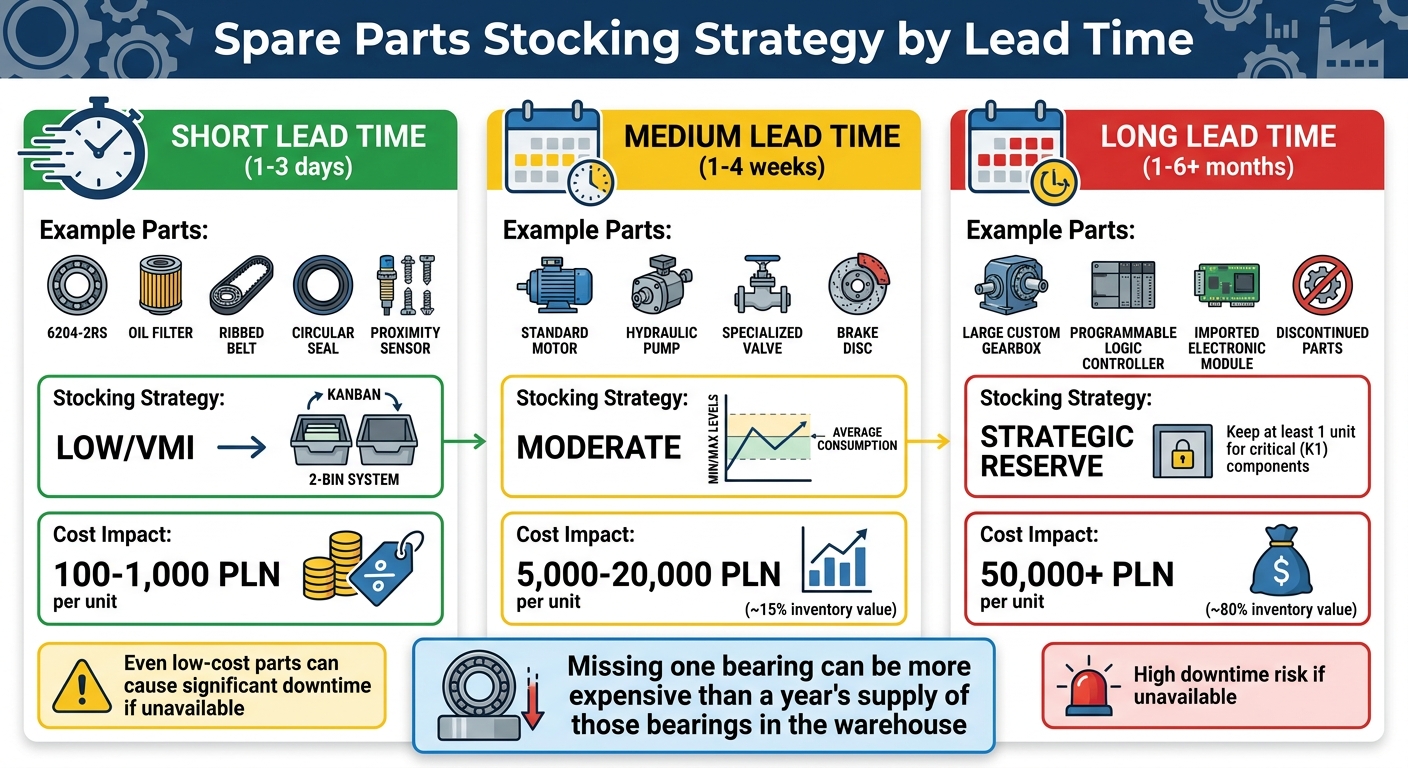
Spare Parts Lead Time Classification and Stocking Strategy Guide
This table organizes spare parts by lead time, helping you make smarter stocking decisions. It's designed for quick reference and highlights key considerations for each category.
| Lead Time Category | Example Parts | Stocking Recommendation | Cost Impact (PLN) |
|---|---|---|---|
| Short (1–3 days) | Standard bearings (e.g., 6204-2RS), filters, belts, seals, sensors, screws | Low/VMI: Use a Kanban or 2-bin system for high-rotation items | Low purchase cost (100–1,000 PLN per unit); even low-cost parts, if unavailable, can lead to significant downtime costs |
| Medium (1–4 weeks) | Standard motors, hydraulic pumps, specialized valves, brake discs | Moderate: Maintain Min/Max levels based on average consumption | Medium capital lock (5,000–20,000 PLN per unit; ~15% inventory value) |
| Long (1–6+ months) | Custom gearboxes, PLCs, imported modules, discontinued parts | Strategic Reserve: Keep at least 1 unit for critical (K1) components | High capital investment (50,000+ PLN per unit; ~80% inventory value with significant downtime risk) |
While short lead time parts are relatively inexpensive, their absence can have costly consequences. As Techneau aptly states:
"Brak jednego łożyska może być droższy niż roczny zapas tych łożysk w magazynie"
(Missing one bearing can be more expensive than a year's supply of those bearings in the warehouse).
On the other hand, long lead time parts require significant capital investment. For example, a custom gearbox might cost over 50,000 PLN, but having it in stock can prevent production halts that would cost far more. The challenge lies in balancing the cost of holding inventory against the potential losses caused by downtime.
To refine your spare parts strategy, consider using ABC/XYZ analysis. High-value parts with steady demand (AX category) should be closely monitored, while low-value, irregularly used parts (CZ category) can often be ordered as needed, provided lead times are manageable.
This approach supports the broader goal of reducing downtime by aligning inventory management with production risks. By categorizing parts effectively, you can optimize stock levels to ensure smooth operations.
Conclusion
The seven strategies discussed here move away from reactive maintenance and focus on ensuring spare parts are available when needed. By properly identifying, categorizing, and sourcing critical components, you can build a system that minimizes costly disruptions and keeps operations running smoothly.
In Polish industries, something as small as a 200 PLN sensor can bring a production line to a standstill, costing hundreds of thousands of PLN per day in lost output. As Billy Cassano puts it:
"Effective parts management is more than just keeping shelves stocked; it's about ensuring the right components are available when needed most".
This reality underscores why these strategies are so important. They help balance inventory costs against the risks of downtime. For example, using criticality classifications (K1, K2, K3) and lead-time analysis ensures you don’t tie up too much capital in slow-moving items while keeping essential components readily available. Standardization also plays a key role by reducing the number of unique parts to manage, making technician training easier and speeding up repairs.
Integrating tools like CMMS, ERP systems, and automated procurement takes spare parts management to the next level. This data-driven approach eliminates issues caused by outdated records, preventing stock shortages or mismatched orders. Digital tools also help maintain a lean and accurate inventory.
Together, these strategies strengthen your facility’s ability to handle unexpected challenges. By combining smart spare parts planning with digital tools, your team is better equipped to deal with equipment failures quickly and efficiently. In Poland’s competitive industrial sector, this proactive approach is key to reducing downtime, cutting costs, and maintaining operational continuity.
FAQs
How do I calculate if a spare part is worth stocking?
When determining whether a spare part is worth keeping in stock, focus on three main factors: how critical the part is, how often it’s needed, and what happens if it’s unavailable.
Start by sorting parts based on their importance and usage. Then, dig into historical data to see how often these parts have been used. Don’t forget to factor in lead times - how long it takes to get the part if it’s not in stock.
The goal is to find the right balance between the cost of holding stock and the risk of downtime. This way, you ensure that essential parts are on hand when needed, keeping disruptions to a minimum and managing your inventory effectively.
What’s the quickest way to start K1–K3 criticality for spares?
To efficiently manage spare parts, start by classifying them based on their importance using an ABC/XYZ analysis. This approach considers three key factors: purchase cost, usage frequency, and operational criticality.
Here’s the process:
- Identify critical spares (K1–K3): Focus on parts with a high operational impact. These are the ones that could significantly affect operations if unavailable.
- Set safety stock levels: For these critical items, establish appropriate safety stock to avoid shortages.
- Use demand forecasting: Predict future needs to ensure essential spares are always available.
By prioritising the most important spare parts, this method helps streamline the criticality assessment process and minimise downtime, keeping operations running smoothly.
How can I link PdM alerts to automatic spare parts ordering?
To link predictive maintenance (PdM) alerts with automatic spare parts ordering, you’ll need to integrate an AI-powered PdM platform with your inventory management system. This combination allows the platform to analyze machine data, forecast potential failures, and trigger alerts. At the same time, it can automate the reordering process by checking stock levels and initiating procurement when necessary.
For this to work smoothly, ensure the systems communicate effectively. This can be achieved using APIs or by integrating with an ERP system. Such a setup helps streamline the procurement process and reduces downtime by ensuring critical parts are managed proactively.