

Downtime costs manufacturers money - fast. When a critical part fails, especially one that's obsolete, production halts, deadlines are missed, and revenue takes a hit. The key? Acting immediately and knowing where to look for replacements. Here's a quick breakdown of what to do:
- Start with Internal Inventory: Check surplus stock, unused parts, or decommissioned equipment. Ensure compatibility with firmware and hardware versions.
- Contact OEMs and Distributors: Reach out to manufacturers or specialized suppliers for documentation, alternatives, or discontinued stock.
- Use Multiple Channels: Simultaneously search surplus marketplaces, repair shops, and distributors to increase your chances of finding the part quickly.
- Verify Supplier Reliability: Look for warranties, testing certifications, and traceability to avoid counterfeit parts.
- Consider Alternatives: If the exact part is unavailable, explore Form-Fit-Function equivalents or modern replacements, but validate compatibility thoroughly.
Preparation is just as important as action. Keep detailed records of your equipment, monitor part lifecycles, and build relationships with trusted suppliers like Gal-Industry, who provide fast shipping, warranties, and cross-referencing expertise. By planning ahead, you can minimize downtime and avoid scrambling during emergencies.
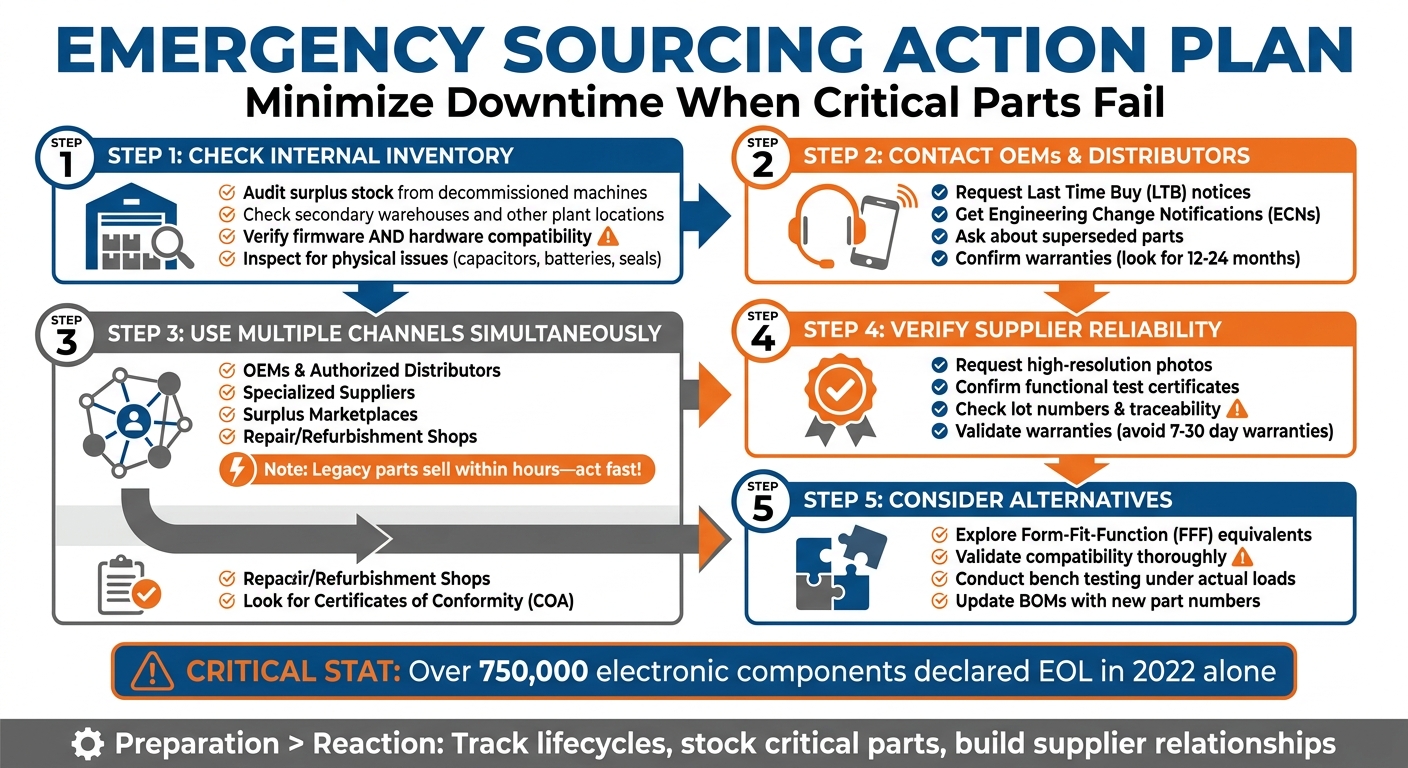
Emergency Sourcing Process for Obsolete Industrial Parts
Obsolescence Management in Manufacturing Explained: Prevent Downtime from Obsolete Parts
sbb-itb-52f18a4
First Actions During an Emergency
When a critical component fails, the first few hours are crucial in determining how long your production line will remain idle. Quick action on multiple fronts can significantly reduce downtime and losses. Facility managers who methodically check sources one at a time often waste precious time, especially when legacy inventory moves fast - what’s available now might be gone in just an hour.
Check Your Internal Inventory
Start by auditing your internal inventory before reaching out to external suppliers. Many companies already have the parts they need but lack visibility across sites. Check surplus stock from decommissioned machines, unused inventory in secondary warehouses, or dead stock at other plant locations. A centralized inventory system can streamline this process.
However, simply finding a part number in your CMMS isn’t enough. You need to confirm compatibility for both firmware and hardware revisions. A PLC module sitting on a shelf for years might have the correct part number but could still be incompatible due to outdated firmware. Additionally, inspect for physical issues like dried-out capacitors, dead lithium backup batteries, or hardened rubber seals.
If your internal search doesn’t yield results, escalate quickly to external sourcing options.
Contact OEMs and Specialized Distributors
Reach out to OEMs first. They can provide critical documentation, such as Last Time Buy (LTB) notices, Engineering Change Notifications (ECNs) for certified alternatives, and information on superseded parts that can serve as direct replacements.
If the OEM confirms stock depletion, turn to specialized distributors. These suppliers often maintain global networks with access to discontinued parts. Many offer warranties - sometimes up to 24 months - on obsolete components and provide functional test certificates and lot numbers to verify authenticity.
When OEM and specialized distributor options are exhausted, widen your search to include alternative sourcing channels.
Use Multiple Sourcing Channels at Once
Simultaneously contact a variety of suppliers - OEMs, authorized distributors, surplus marketplaces, and repair shops. Legacy components often have unpredictable availability; what’s listed by one supplier today might be sold within hours.
Here’s a quick breakdown of sourcing channels and their benefits:
| Sourcing Channel | Primary Benefit | Key Action Item |
|---|---|---|
| OEM / Authorized | Reliable documentation and authenticity | Obtain LTB notices and ECNs |
| Specialized Suppliers | Access to tested, discontinued stock | Confirm warranty and test reports |
| Surplus Marketplaces | Broad availability of rare parts | Compare lot photos and branding |
| Repair/Refurbishment | Quicker turnaround for modules | Request functional test certificates |
When searching online, use multiple formats of the part number. Include variations with and without dashes, spaces, or prefixes. Broaden your search terms to include phrases like “discontinued PLC” or “legacy relay” alongside the specific model number to uncover hidden listings. Given the high demand for obsolete components, act quickly on quotes to secure the part.
How to Find Reliable Suppliers for Obsolete Parts
What to Look for in Emergency Suppliers
In emergencies, every second counts, and choosing the right supplier can make all the difference. A dependable supplier should offer complete transparency about their inventory. This includes using serialised inventory systems and providing high-resolution photos of the parts - showing packaging, markings, and terminal connections. Such details help confirm the condition and authenticity of the components.
Another hallmark of a reliable supplier is their commitment to rigorous testing and validation. Look for those who provide functional test results, calibration certificates, and bench test data. For critical parts, suppliers may even conduct a 24-hour burn-in test to identify potential early failures. Additionally, trusted vendors will supply Certificates of Conformity (COA), lot numbers, and traceability documentation to verify a part's origin and quality.
Warranty coverage is another key factor. Suppliers offering warranties of 12–24 months demonstrate confidence in their products. On the other hand, short-term warranties (7–30 days) can be a warning sign. Lastly, consider the supplier's expertise in your industry. Those with a proven track record in areas like process control or heavy manufacturing are better prepared to handle urgent and complex needs. One supplier that ticks all these boxes is Gal-Industry.
Gal-Industry: Your Partner for Sourcing Obsolete Parts
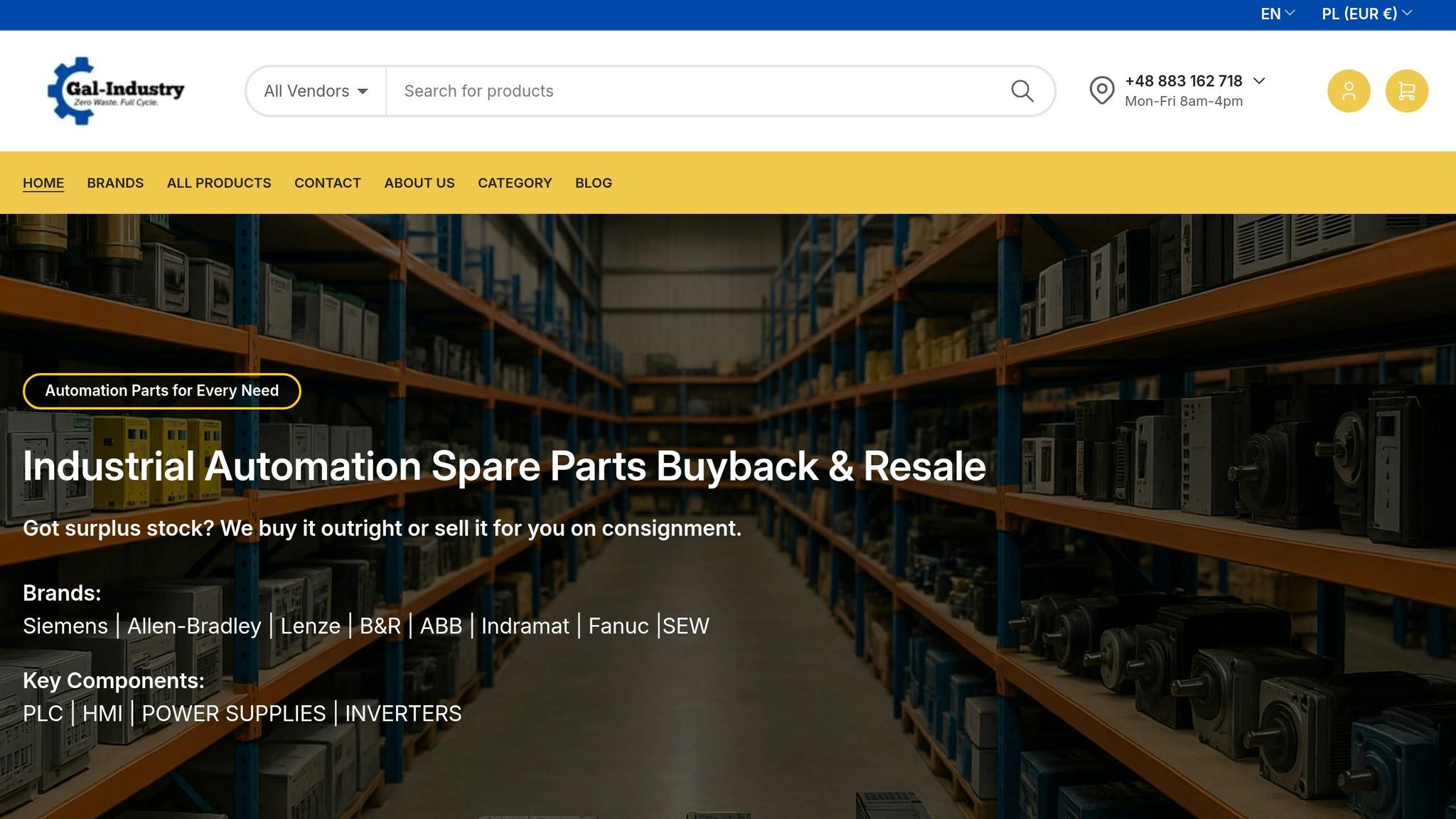
When production grinds to a halt, having a reliable partner like Gal-Industry can save the day. Specialising in rare and discontinued industrial automation parts, they stock components from top brands like Siemens, ABB, Allen-Bradley, and Schneider Electric. Their inventory includes essentials like PLCs, HMIs, power supplies, and inverters - all available in real time to aid swift decision-making.
Gal-Industry understands the urgency of emergencies, offering same-day shipping for orders placed before 4 PM CET. Their quality assurance process includes multi-point testing - covering electrical and load checks - to ensure every part meets OEM standards.
To back their products, Gal-Industry provides warranties of up to 24 months for new parts and extended coverage for refurbished items. If the exact part you need is unavailable, their expertise in cross-referencing helps identify alternative options, whether it's a Form-Fit-Function equivalent or a modern retrofit. Plus, their 14-day free return policy reduces the risks of integration issues.
How to Verify Authenticity and Avoid Counterfeits
Protecting your supply chain means verifying the authenticity of every component. Counterfeit parts can pose serious safety risks and complicate insurance claims. Start with a close physical inspection: authentic parts will feature precise OEM fonts, consistent label spacing, and accurate CE/UL markings. Request high-resolution images of labels, terminal connections, and heat sink edges to identify any inconsistencies.
Serial numbers should follow OEM standards, and packaging is another telltale sign. Genuine OEM packaging includes custom-cut foam, properly printed anti-static bags, and distinct barcode placement.
"Hardware can be copied. Firmware cannot." - Bryan Hellman, Industrial Automation Co.
For programmable modules, firmware validation is essential. Counterfeit units often fail to integrate with OEM software like TIA Portal, GX Works, or Sysmac Studio. Before full deployment, bench test third-party parts under typical electrical loads to uncover compatibility or performance issues that visual inspections might miss.
| Indicator | Authentic Component | Counterfeit Red Flag |
|---|---|---|
| Labelling | High-precision printing with exact OEM fonts | Smudged, blurry, or low-quality printing |
| Materials | Durable resin blends and consistent metal finishes | Inconsistent plastics or mismatched screws |
| Serial Numbers | Standardised logic with unique identification | Random sequences or duplicate numbers |
| Software | Seamless integration with OEM programming tools | Errors like "unsupported device" notifications |
| Warranty | 12 to 24 months | Short warranties (7–30 days) or "final sale" |
What to Do When Exact Parts Are Unavailable
What Are Form-Fit-Function Equivalents?
When a part is discontinued, Form-Fit-Function (FFF) equivalents can serve as a practical solution. Here's how it breaks down: Form refers to the physical dimensions and mounting style, Fit involves compatibility with interfaces like pinout and PCB footprint, and Function ensures the part matches the original in terms of electrical and performance characteristics.
A drop-in replacement is ideal because it shares the same symbol, footprint, and pinout as the original, meaning no changes are needed for your PCB or circuit design. Equivalent components are similar in electrical specifications, while alternative parts may require some design modifications.
"A good practical rule is: if Form and Fit are identical and Function is equal or better within safe margins, treat the part as a drop-in replacement; if any of the three differs, plan at least limited revalidation." - ichome.com
Understanding these FFF equivalents is crucial, especially for teams managing industrial automation equipment. With technology nodes shrinking and supply chain disruptions becoming more frequent, part discontinuation is increasingly common. Once you understand FFF criteria, the next step is thorough validation of any proposed substitute.
How to Validate Compatibility of Substitute Parts
Finding a substitute part is just the beginning - it must be validated to ensure it performs as needed. Start by using parametric search tools from distributors, filtering by electrical ratings, voltage, current, and temperature range. Check manufacturer-recommended replacement tables, especially for discontinued logic families or regulators. Whenever possible, stick to replacements from the same manufacturer's part family to maintain consistency.
The level of validation depends on how critical the component is. For safety-critical parts, perform full bench and environmental tests. For medium-risk components, focus on electrical comparisons. For low-risk items, a thorough datasheet review might suffice.
Before rolling out the substitute, conduct bench testing under actual electrical loads and temperature conditions. For critical modules, include a 24-hour burn-in period to confirm stability. Pay close attention to timing characteristics, logic thresholds (Vcc), and thermal dissipation to ensure compatibility with your equipment. Always involve design engineers in the process - purchasing teams should not make these decisions alone.
Once the substitute is validated, update your internal schematics and Bill of Materials (BOM) with the new part numbers, supplier details, and datasheets. This documentation will be invaluable for future maintenance. After technical validation, minimize integration risks by categorizing the replacement appropriately.
Managing Risks When Using Alternative Parts
Replacement parts can be grouped into three categories: drop-in, equivalent, or alternative. Each type comes with its own validation and redesign requirements.
| Replacement Type | Physical Fit (Footprint/Pinout) | Electrical Specifications | Redesign Required? |
|---|---|---|---|
| Drop-in Replacement | Identical | Identical | No |
| Equivalent Component | May differ (different package) | Same or very close | Possible (PCB layout) |
| Alternative Component | Likely different | Different but adequate | Yes (Circuit/Layout) |
To reduce the risk of counterfeit parts, always source replacements from authorized distributors. When End-of-Life (EOL) components become unavailable, some bad actors may use SEO tactics to appear as legitimate vendors with stock. If working with brokers for EOL inventory, ensure rigorous third-party testing and inspection. For high-stakes applications, use non-destructive testing methods like X-ray Fluorescence (XRF) to verify material composition.
Always request traceability documentation, such as lot numbers, Certificates of Authenticity (COA), and datasheets, especially for safety-critical parts. If sourcing from third-party or refurbished channels, negotiate a limited operational warranty (at least 30 days) to reduce risk. Lastly, confirm that the substitute part will remain available for at least two to three years to avoid repeating this sourcing process in the near future.
"Obsolescence is a manageable risk if you take the time to do it." - Mouser Electronics
How to Prepare for Future Emergencies
While quick sourcing can help reduce downtime during emergencies, planning ahead is what truly ensures you're ready for the future. Consider this: in 2022, over 750,000 electronic components were declared end-of-life (EOL), followed by another 470,000 in 2023. With product lifecycles shrinking - especially in industries like automotive, IoT, and consumer electronics - parts that used to last a decade now become obsolete in just a few years. The real challenge isn’t whether your equipment will face obsolescence, but whether you’ll handle it proactively or get caught off guard during a critical failure.
Track Component Lifecycles and Use Predictive Maintenance
Start by auditing your production lines. Record key details like part numbers, serial numbers, firmware versions, installation dates, and maintenance history. Having this information digitized allows you to quickly identify replacement needs. Sign up for Product Change Notices (PCN) and EOL alerts from manufacturers or specialized distributors to get 12–24 months' advance notice.
Organize components by their criticality, lead times, and lifecycle stages. For high-risk parts with no alternatives and long lead times, plan for buffer inventories and upgrades. Medium-risk parts with available replacements require validation and regular monitoring. Low-risk, standard components can rely on just-in-time inventory systems. For example, PLCs often have lifecycles of 10–15 years, while the systems they control may run for 15–25 years. This mismatch makes lifecycle tracking absolutely necessary.
"The question is not whether your automation equipment will encounter obsolescence. The question is whether you will manage it proactively or discover it during an unplanned downtime event at 2 a.m. on a Friday." - AMD Machines
Enhance your inventory system by adding lifecycle data and usage history. Outdated or inaccurate material records can lead to procurement errors and stockouts, even for parts still in production. Consider using AI-powered tools or ERP integrations to flag discontinuations early and suggest replacements. A solid benchmark for managing lifecycle costs is allocating 2% to 4% of your total automation asset value annually.
Stock Critical Parts and Use Dual-Sourcing
When you receive an EOL notice, calculate buffer stocks based on realistic forecasts and the remaining lifespan of your assets. For essential components that could halt production if they fail, keep on-site spares and purchase last-time-buy quantities to cover the equipment’s entire service life.
Standardizing components across production lines can simplify inventory management and cut costs. Facilities that use common drive families or PLC platforms report savings of up to 20–30% on spare parts. Reducing the variety of components also makes it easier to manage lifecycle statuses.
For long-term preparedness, establish relationships with at least two verified suppliers for critical components. Build a database of qualified alternatives before a crisis hits to minimize the need for emergency redesigns. Document modernization plans for key systems while they’re still operational, rather than scrambling to reverse-engineer a failed system under pressure.
"Obsolescence management is a capital-allocation discipline: protect uptime while preventing dead stock accumulation." - Andrew Bennett, Product Lead, SPARETECH
Additionally, having strong supplier partnerships can further secure your operations.
Build Relationships with Trusted Suppliers
Beyond inventory and sourcing strategies, cultivating long-term relationships with suppliers strengthens your ability to manage risks. Reliable partners can offer priority access to inventory and fast responses, such as overnight shipping instead of waiting weeks when you’re in a bind. Distributors often have early insights into EOL timelines, and procurement teams that treat them as partners are better positioned to address shortages and secure replacements.
Develop dedicated contacts at supplier firms who understand your facility’s equipment, maintenance schedules, and risk profile. Share a watchlist of critical components so suppliers can set up automated alerts for availability in secondary markets. For example, Gal-Industry (https://gal-industry.com) specializes in cross-referencing obsolete parts with modern equivalents, helping you avoid costly system redesigns. Their services, including same-day shipping, up to 24-month guarantees, and free returns, provide quick solutions during emergencies.
Take advantage of supplier buyback programs to monetize surplus legacy inventory. This approach not only turns idle stock into credit for newer parts but also supports a circular economy by helping other facilities source rare components. During the design phase, involve suppliers to avoid single-source dependencies and ensure the parts you choose have solid production commitments.
"During supply chain stress, long-term relationships make the difference between 'we'll check back in eight weeks' and 'we'll overnight it today.'" - Bryan Hellman, Industrial Automation Co.
Conclusion
Proactive sourcing and strong supplier partnerships are the backbone of any effective response plan, ensuring operational stability in manufacturing. Downtime is one of the most expensive challenges you can face, but it doesn't have to catch you off guard. The solution lies in moving from reactive problem-solving to proactive preparation - this means keeping detailed records of critical equipment, staying on top of end-of-life (EOL) notices, and building relationships with reliable suppliers well before a crisis occurs. When equipment fails, having a pre-vetted supplier network and organized inventory can make the difference between a brief disruption and a prolonged production halt.
Begin sourcing from multiple channels now, checking part authenticity through visual inspections and burn-in tests, and consider form-fit-function alternatives when exact replacements are unavailable. Specialist distributors like Gal-Industry (https://gal-industry.com) offer tested obsolete components with up to 24-month warranties, same-day shipping, and expert cross-referencing to ensure proper replacements.
A well-thought-out spare parts strategy transforms crisis management into a stable, predictable process. Identify critical failure points, standardize components to reduce costs, and reinvest in proactive spare parts management to ensure uninterrupted production. Additionally, buyback programmes offer an opportunity to monetize unused inventory and redirect those funds toward essential spares.
Obsolescence is inevitable - it’s not a question of "if" but "when." The real challenge is whether you’ll manage it strategically or face it unprepared during an emergency. By adopting these practices into your maintenance protocols, you can safeguard your operations and maintain smooth production workflows, even when sourcing parts through standard channels becomes difficult. With thorough preparation, the right supplier partnerships, and robust sourcing strategies, your operations can remain resilient no matter what challenges arise.
FAQs
What info should I collect before calling suppliers?
Before reaching out to suppliers for obsolete parts, make sure you’ve collected all the essential details. This includes part numbers, model numbers, and firmware versions. Additionally, consider the role the component plays in your operations and any specific requirements it must meet. Determine whether you need the part to be new, refurbished, or compatible. Being well-prepared not only ensures smoother communication but also helps you get the right part without delays.
How can I quickly tell if an obsolete part is counterfeit?
To spot a counterfeit obsolete part, pay attention to details like inconsistent markings, subpar build quality, or any branding discrepancies. These can be red flags indicating the part isn't genuine. To confirm its authenticity, consult trusted suppliers or review the official documentation associated with the part. For added security, always procure components from reliable and verified sources to reduce the risk of counterfeits.
When is an FFF substitute safe, and when is revalidation needed?
Once an FFF substitute has been validated, it is considered safe for use. However, revalidation becomes necessary if there have been any modifications to the substitute or changes in operating conditions. These alterations could affect its performance or safety. If no such changes have occurred, revalidation might not be required.