

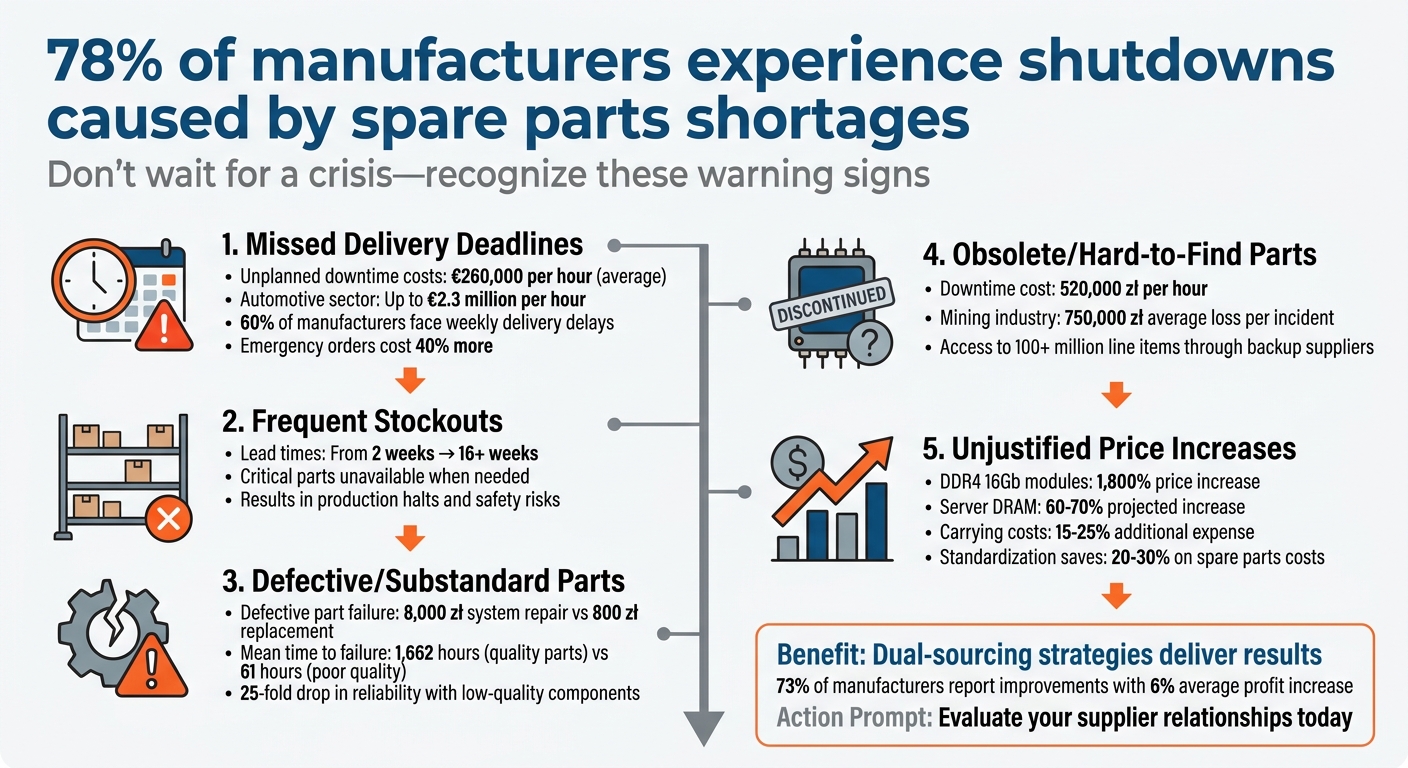
When your production line is at risk of halting due to missing or delayed parts, the financial and operational consequences can be immense. Here’s the bottom line: 78% of manufacturers experience shutdowns caused by spare parts shortages, and lead times for critical components are becoming even longer. If you rely on a single supplier, you’re exposing your business to unnecessary risks. Below are five key warning signs that indicate it’s time to establish a backup spare parts supplier:
- Missed delivery deadlines: Delays force costly emergency measures and unplanned downtime, which can cost up to €260,000 per hour in manufacturing.
- Frequent stockouts: Critical components unavailable? That’s a direct threat to your operations and customer commitments.
- Defective or poor-quality parts: Low-quality replacements can cause breakdowns, safety risks, and skyrocketing costs.
- Obsolete or hard-to-find parts: When OEMs discontinue components, you’ll need alternative sources to avoid expensive system upgrades.
- Unjustified price increases: Sudden price hikes, often unrelated to raw material costs, can disrupt your budget and force reactive purchases.
Why Act Now?
A backup supplier minimizes downtime risks, ensures access to critical parts, and offers pricing flexibility. Whether it's sourcing legacy components, avoiding inflated costs, or securing reliable delivery, having a secondary supplier is a smart way to protect your operations and finances. Don’t wait for a crisis - evaluate your current supplier relationships and address these vulnerabilities today.
5 Warning Signs You Need a Backup Spare Parts Supplier
1. Your supplier consistently misses delivery deadlines
When suppliers fail to meet delivery deadlines, it can throw your entire operation into chaos. Production lines grind to a halt, costs spiral, and facilities sit idle - what Elon Musk once called "money furnaces." And he’s right. The financial impact of downtime adds up fast.
Here’s the reality: unplanned downtime costs manufacturers an average of €260,000 per hour. For the automotive sector, those losses can skyrocket to as much as €2.3 million. To make matters worse, 60% of manufacturers report experiencing delivery delays on a weekly basis, and recovery times have stretched from 49 minutes to a staggering 81 minutes.
Missed deadlines don’t just delay production - they force costly decisions. Emergency orders with expedited shipping can cost up to 40% more. Workers often face overtime pay at rates up to double the norm. Meanwhile, maintenance teams are stuck reacting to problems instead of preventing them, and production teams may even be left scrambling to adapt alternative parts that require extra engineering work. What could’ve been a quick fix suddenly becomes a multi-day issue.
"The expensive option is waiting days or weeks on lead-time." – Bryan Hellman, Industrial Automation Co.
If you notice a pattern of late deliveries from your supplier, it’s a red flag. Consistently late parts don’t just slow down production - they expose weaknesses in your supply chain. In these situations, it becomes crucial to monitor delivery times closely and consider securing a reliable backup supplier to avoid prolonged downtime and unnecessary costs.
sbb-itb-52f18a4
2. Critical parts are frequently out of stock
Frequent stockouts aren’t just an inconvenience - they can bring your operations to a grinding halt. When essential components aren’t available, production stops, and maintenance teams are forced into firefighting mode, addressing immediate breakdowns instead of focusing on preventative care.
The statistics paint a grim picture. Lead times for critical parts can balloon from just two weeks to over sixteen weeks - or even longer. What used to be a quick fix turns into months of waiting while your equipment sits idle.
"In manufacturing, even short periods of unplanned downtime due to missing or obsolete spare parts can result in lost production, delayed deliveries, and reputational damage." – SPARETECH
The impact doesn’t stop at financial losses. Missing parts can lead to equipment failures that pose safety risks and may even result in regulatory violations. On top of that, broken commitments due to delays can erode customer trust, making it harder to maintain long-term relationships.
As machinery becomes more advanced, ensuring a steady supply of parts is more challenging than ever. Tracking the lifecycle of critical components becomes increasingly complex, and outdated inventory records can lead to "phantom stock" - parts that appear available but are unusable due to age or incompatibility. This is where having a backup supplier with diversified sourcing channels becomes essential. Whether it’s new, surplus, or refurbished parts, a reliable secondary supplier can bridge the gap when your primary source falls short. These stockouts highlight the importance of proactive planning to keep operations running smoothly.
3. You receive defective or substandard components
Faulty replacement parts can lead to equipment breakdowns, hazardous conditions, and rising costs due to repeated replacements and prolonged downtime.
Even the smallest component - a sensor or a bearing - can bring production to a standstill, causing major revenue losses. This highlights the importance of having a backup supplier that enforces strict quality standards.
"Even small mismatches can cause nuisance faults, premature failure, or unsafe operating conditions. These issues may only appear days or weeks later." – Bryan Hellman, Industrial Automation Co.
The risks aren't always obvious. A part might look perfect but could have hidden electrical or thermal damage, only revealing problems after installation. In motion and drive systems, even components that are physically identical can malfunction if their firmware versions differ, creating unexpected faults and expensive downtime. Moreover, parts stored improperly - exposed to humidity, electrostatic discharge, or poor temperature control - can fail the moment they're put to use, regardless of their original quality.
The financial consequences can be steep. While replacing a worn-out part might cost around 800 zł, a system failure caused by a defective component can escalate to as much as 8,000 zł. To put it into perspective, well-maintained systems often reach a mean time to failure of 1,662 hours. In contrast, systems using low-quality parts might see that number plummet to just 61 hours - a staggering 25-fold drop in reliability. This is why having a dependable backup supplier with stringent quality checks isn't just a good idea - it's a necessity to safeguard your operations from unnecessary risks.
4. Your supplier cannot find obsolete or hard-to-find parts
When your main supplier can't source discontinued components, it creates a serious problem. Authorized distributors typically stock only current, active product lines. Once a manufacturer discontinues a part, it essentially disappears from their offerings. This leaves you scrambling for alternatives when a critical piece of equipment - like a sensor, motor controller, or PLC module - fails after years of use. These situations highlight the importance of having a backup supplier to secure legacy components. The ripple effects of such shortages can disrupt operations and lead to significant financial losses.
The financial stakes are high. Unplanned downtime can cost around 520,000 zł per hour, and in industries like mining, a single incident can average 750,000 zł in losses. On top of that, reactive purchases made in desperation can lead to compromises in quality and compatibility, further adding to costs.
"Obsolescence management is not a warehouse topic; it is uptime risk engineering combined with working-capital control." – Jan Wenger, Customer Success Team Lead, SPARETECH
The real challenge isn't just finding a replacement part - it’s finding the exact match for your existing systems. Newer products rarely integrate seamlessly. They often require reprogramming, I/O rewiring, or even a full system reconfiguration. This is where a backup supplier with access to specialized sourcing networks becomes invaluable. They can locate surplus, refurbished, or used components, keeping older equipment functional without forcing expensive upgrades.
Without this kind of support, your options are limited. You can either stockpile parts - risking degradation over time and tying up capital - or face prolonged shutdowns when components fail. A backup supplier with access to a global inventory of over 100 million line items can bypass these issues, sourcing parts that authorized distributors simply cannot reach [28,30]. This makes a backup supplier essential for maintaining continuous operations in industrial automation.
5. Prices keep increasing without transparent rationale
Sudden price hikes can be a red flag. For instance, in January 2026, copper prices surged by over 35%, aluminium by about 40%, and silver skyrocketed by more than 250% compared to the previous year. While fluctuations in raw material costs are normal, not all price increases stem from actual market conditions. Some suppliers take advantage of market instability to boost their profit margins or impose inconsistent pricing on older product lines. These patterns often point to strategic pricing decisions rather than genuine cost pressures.
Take 2025 as an example: DDR4 16Gb modules saw a staggering 1,800% price increase, and server DRAM was projected to rise by 60–70% in early 2026. These components, essential for PLCs and industrial computers, highlight how such volatility compounds the already complex supply chain challenges. When critical parts experience steep price jumps without clear justification, it often signals a supplier's internal pricing adjustments rather than external cost drivers.
"If we spend January chasing a 5% saving on individual components, we risk paying ten times that price in October through downtime penalties and missed delivery windows." – Automation Trader
Carrying costs further amplify the issue, adding 15–25% to the overall expense of parts. For example, an 850,000 zł system initially incurs around 17,000 zł in inventory costs, which can rise to 4,250 zł annually by the sixth year. When prices climb without a clear explanation, these hidden costs grow, leaving businesses with two difficult choices: tie up capital in excessive stock or pay inflated "panic prices" during emergencies.
This kind of price volatility makes budgeting unpredictable. One way to break out of this cycle is by having a backup supplier. Standardising components - like using common drive families or PLC platforms across machines - can cut spare parts costs by 20% to 30%. Additionally, exploring cross-brand substitutions or sourcing surplus and refurbished components can provide pricing flexibility when your main supplier's costs spiral out of control. Without these alternatives, you risk being at the mercy of unjustified price surges.
Benefits of a Backup Spare Parts Supplier
Having a secondary supplier can significantly reduce production risks. With 78% of manufacturers reporting shutdowns due to spare parts shortages, the issue isn't whether you need a backup supplier - it's how quickly you can set one up. A second supplier minimizes the dangers of relying solely on one vendor, especially when dealing with critical components like legacy drives that often come with lead times of 8–12 weeks. This kind of risk management can lead to immediate financial advantages.
The financial stakes are high. Take, for example, a single failed drive worth 12,000 zł. If a replacement isn't readily available, the resulting downtime can lead to six-figure losses from halted labour and delayed orders. Local Polish suppliers, such as Prasmet in Świdnica, offer a distinct advantage here. Equipped with in-house tool shops, they can produce die inserts or punches within hours during emergencies, avoiding the extended delays often associated with offshore suppliers.
"The difference between a controlled shutdown and a production crisis usually comes down to one thing: Was the right part available at the right time?" – Chief Automation
Backup suppliers also play a crucial role in supporting legacy systems. When OEMs discontinue support for older production lines, secondary suppliers step in to source refurbished or salvaged parts. Many even provide exchange programmes or reprogram universal units to meet discontinued specifications - services that primary suppliers rarely offer. This is particularly important in Poland's heavy industry, where something as small as an inexpensive sensor can bring a production line generating hundreds of thousands of złoty in daily revenue to a grinding halt.
Another key benefit is cost stability. Framework agreements with secondary suppliers ensure fixed pricing and guaranteed response times, shielding you from the inflated costs of panic buying during emergencies. Instead of tying up capital in excessive inventory - which can incur annual carrying costs of up to 25% - you can rely on these relationships for next-day delivery of critical components. This approach shifts spare parts management from being a reactive process to a strategic method of risk control, ensuring uninterrupted operations in industrial automation.
Conclusion
The five warning signs highlighted earlier reveal vulnerabilities that could lead to costly shutdowns. When a critical component fails, having a backup supplier is not just a luxury - it’s a necessity.
Take a moment to evaluate your supplier relationships against these warning signs. If any resonate, it’s time to act. Start by focusing on the most critical 10–20% of your SKUs, which often account for 70–80% of your annual consumption value. Identify components - such as Siemens S7-1200 PLCs or Yaskawa GA800 VFDs - that would immediately halt production if unavailable. Prioritize these failure points by setting up dual-sourcing arrangements.
"A resilient spare parts strategy doesn't just protect your operations; it transforms maintenance from reactive firefighting into proactive stability." – Bryan Hellman, Industrial Automation Co.
The numbers back this up: 73% of manufacturers who implemented dual-sourcing strategies reported tangible improvements, including an average profit increase of 6% thanks to better supplier coordination. Instead of tying up capital in excessive inventory - often costing 20% to 30% of its value annually - you can depend on trusted backup suppliers for quick access to essential components.
FAQs
Which parts should I dual-source first?
When it comes to maintaining uninterrupted production, it’s essential to focus on the components that have the biggest impact on operations. These are typically high-impact parts like PLCs, drives, motors, sensors, and communication modules. Why? Because if one of these fails and isn’t readily available, it could lead to significant downtime.
Pay special attention to parts that are more prone to failure, have extended lead times, or are at risk of becoming obsolete. A smart move is to consider dual-sourcing these critical components. This way, you always have a backup on hand, minimizing the chance of expensive production stoppages.
How do I qualify a backup supplier for quality and traceability?
To ensure a backup supplier meets your needs, start by checking if they adhere to recognised standards like ISO 9001:2015 and provide detailed process documentation. Look into their certifications and evaluate key metrics, such as defect rates and delivery accuracy. It's also essential to confirm their ability to maintain stock for critical components.
Traceability is another crucial factor - verify their use of batch numbers and quality control records to ensure product authenticity and compliance. Don’t forget to request supporting documentation and assess their technical support services to guarantee consistent quality over time.
When is a backup supplier better than stocking more spares?
When supply chains become unpredictable, having a backup supplier can be a game-changer. Challenges such as shortages, extended lead times, or discontinued parts can throw operations off balance. Instead of resorting to overstocking, which ties up resources, a secondary supplier ensures that critical components are always within reach. This helps minimise downtime and keeps production running smoothly, even during disruptions.